Optogenetics wins the 2026 Nobel Prize in Physiology or Medicine
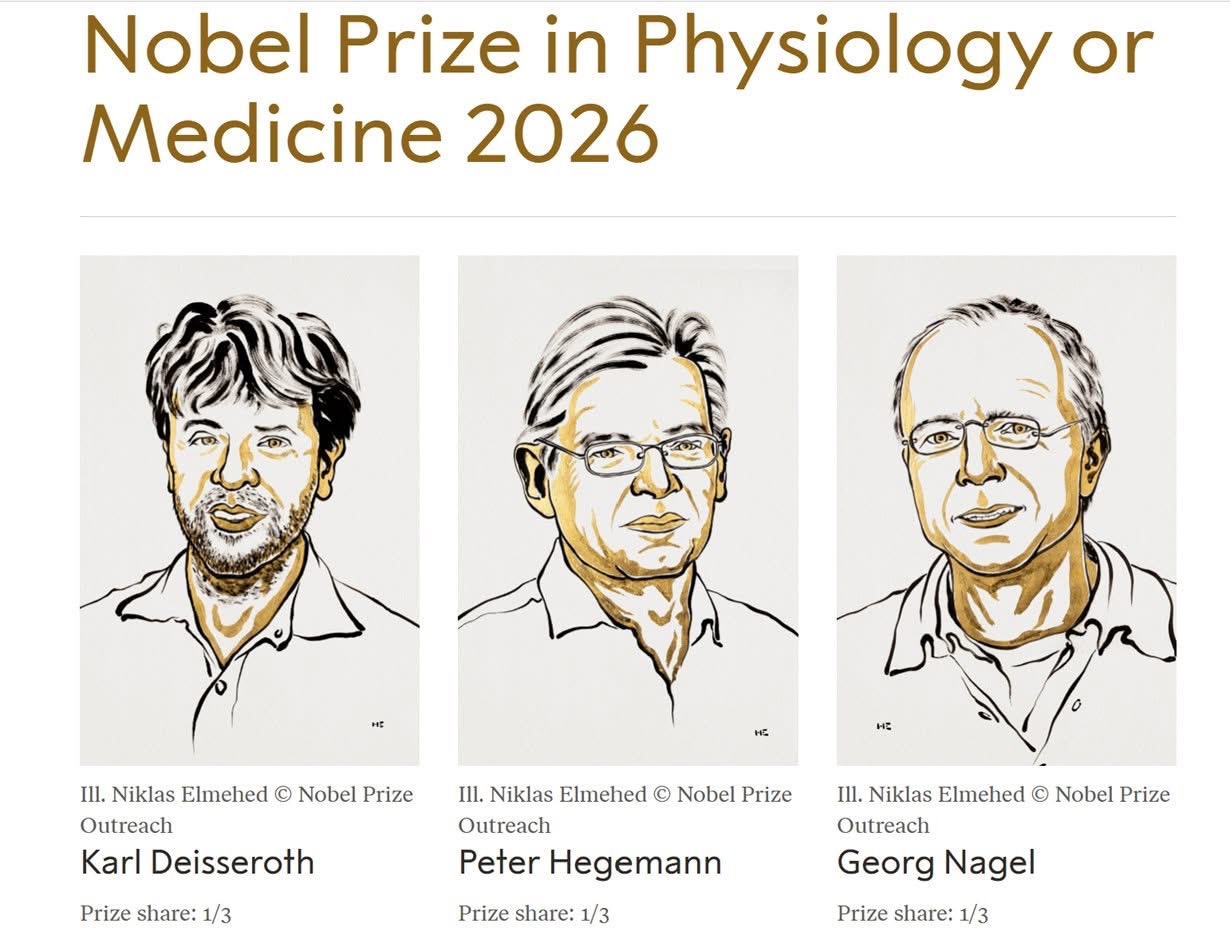
The story begins in a single-celled green alga, Chlamydomonas reinhardtii, which uses light-sensitive proteins to swim toward the sun. In 2002 and 2003, Nagel, Hegemann and colleagues showed that two of these proteins, channelrhodopsin-1 and -2, are ion channels that open directly in response to light. In 2005, Deisseroth's team put channelrhodopsin-2 into mammalian neurons and made them fire with millisecond-precise flashes of blue light. That experiment launched optogenetics, which lets researchers switch specific cell types on or off in the living brain and test what each one does.
The technique is close to home for us. Our PI, Dr. Philip A. Adeniyi, and colleagues at LSU used channelrhodopsin-2 to map how the midbrain's ventral tegmental area (VTA) talks to the hippocampus, a loop that helps decide which experiences become long-term memories. They switched on VTA dopamine or glutamate neurons with blue light while recording from hippocampal CA1. The two inputs did different jobs: dopamine fine-tuned how often active CA1 neurons fired, while glutamate drove stronger firing and bursting across the network. (Adeniyi et al., Neuroscience 2020)
At BRAIV Lab, we carry this circuit-level approach into questions about how the aging brain and its blood vessels shape memory. A discovery that started with pond algae now gives us some of our sharpest tools for studying the brain, which is a good argument for curiosity-driven science.
Learn more about the prize at nobelprize.org.
More Lab News